


No Guest Found in this category
Over 400 years ago, a merchant ship was attacked by pirates of The Singh Brotherhood off the African coast. Amidst the skirmish, the merchant captain’s son saw his father killed, before falling overboard himself. Washing ashore, the young man was nursed to health by a friendly tribe and later found the body of his father’s killer on the beach. After the buzzards had done their work, he made a vow on the pirate’s skull: To dedicate his life to the destruction of piracy, greed, cruelty and injustice. His descendants would follow in his footsteps…
That is a version of The Phantom’s backstory, as it has been presented time and time again, going all the way back to his debut ninety years ago in 1936. While some details have been tweaked here and there, the character has remained surprisingly consistent – a rare feat among fictional characters. Even the likes of Batman and Superman took time to fully establish their lore and are now fairly different to their original iterations.
The Phantom, while not as popular as those more mainstream heroes, has stood the test of time in a way that few others have. And while his influence on the superhero genre is obvious, he remains unique among his costumed colleges, thanks to his mixed origins as a jungle adventurer and pulp hero. So let’s flick through the chronicles and take a peek at the origins of the Phantom legend, and the surprising popularity he’s acquired in our Australian homeland.
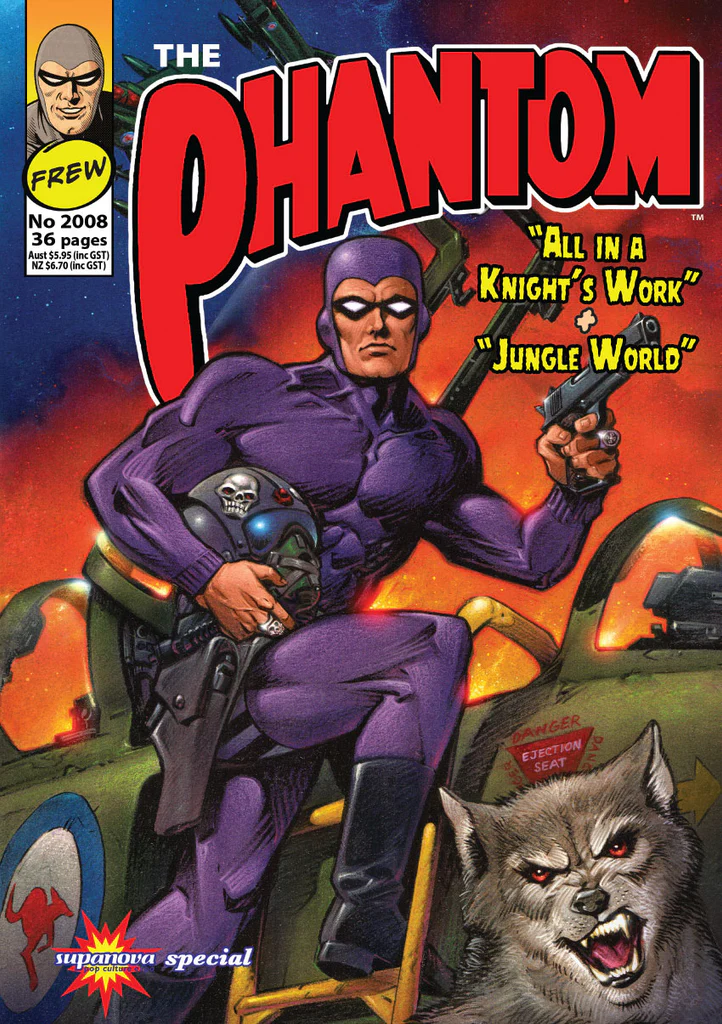
Cover by Ken Steacy
The Phantom newspaper comic strip first went to print on the 17th of February, 1936 and was the creation of American writer Lee Falk. Falk had already made a significant contribution to the burgeoning world of comic strip heroes with the creation of Mandrake the Magician in 1934. However, while Mandrake was at home with other pulp heroes of the 1930s, such as The Shadow and The Spider, The Phantom took the first tentative steps towards the dawn of the superhero.
Whereas Mandrake dressed like a stereotypical stage magician, and other pulp heroes gravitated towards suits, cloaks and overcoats, Falk decked the Phantom out in tights, inspired by Robin Hood, and a domino mask with those iconic white eyes. The later feature was inspired by ancient Greek busts, whose eyes didn’t typically include pupils. The Phantom’s simple but iconic look would set the standard for hundreds of superhero costumes across the following decades and has remained virtually unchanged since.
It is worth noting though, that Falk originally intended for the costume to be grey, which was the case for the characters depictions in the black and white daily strips. It wasn’t until the commencement of a full colour Sunday strip that a miscommunication resulted in the iconic purple costume that the character is so widely known for.
Falk continued to write for both of his newspaper strip creations – Phantom and Mandrake – right up until his death on the 13th of March, 1999. There’s even talk that he was dictating notes from his death bed, with his wife, Elizabeth Moxley, finishing his final Phantom and Mandrake stories after his passing. From there, both strips were taken over by new writers, with Tony DePaul taking on The Phantom strips, which he still works on to this day. Under DePaul’s pen, the strip has adapted to modern sensibilities with a greater sense of continuity, linked narratives and ongoing story arcs.
But let’s rewind and focus in for a moment to look at the Phantom through a distinctly Aussie lens. Almost right from his inception, that purple-clad Jungle hero proved extremely popular here in Australia, where his newspaper strips were first published in The Australian Women’s Mirror, of all places, in December of ‘36. However, it was twelve years later that Australia really made our mark on the character, with the foundation of FREW Publications in 1948. FREW began publishing edited reprints of Falk’s Phantom strips in comic book form, and are still publishing Phantom comic books to this day.
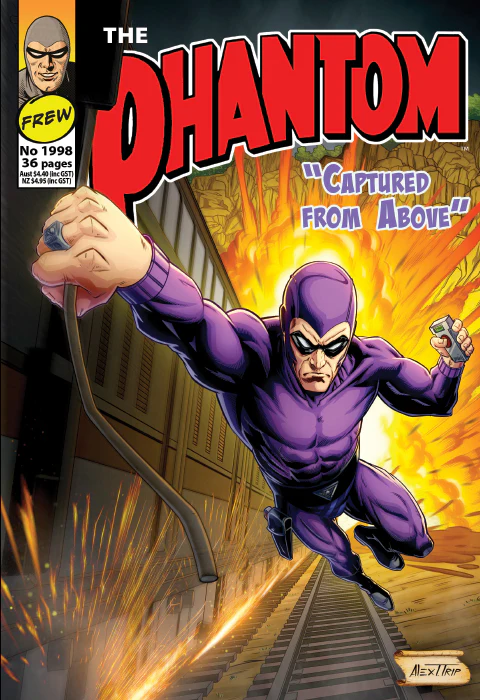
Cover by Alex Trpcevski
It’s those classic FREW books that were responsible for creating generations of Phantom fans, thanks to how often they showed up in show bags at regional shows like The Sydney Royal Easter Show. Even today you can still find the odd FREW Phantom comic book popping up in a random show bag, though the FREW comics of today are a far cry from what your grandpa used to read.
It’s no doubt thanks to FREW that the Phantom became so ingrained into Aussie pop culture for such a long time. From the likes of Paul Hogan and Wally Lewis proudly displaying their love for the character in the ‘70s and ‘80s, to frequent Supa-Star Maria Lewis hosting the The Phantom Never Dies podcast and comedian Sammy J touring his Phantom-inspired Hero Complex show.
As for FREW, they’ve continued to evolve with the times, producing high quality publications, with a diverse range of content. They still publish the newspaper strips, both new and reprints of old Falk stories, but most of their content for the past few decades have been English translations of stories published by Swedish publisher, Fantomen. That’s right, as random as it may seem, after Australia the biggest hub of Phantom lovers is Sweden, with their local Phantom publisher setting up shop in 1950, just two years after our own FREW crew.
Both publishers remain giants in the Phantom world and it really can’t be overstated just how impressive this longevity is. FREW just published Issue 2000 of their Phantom series last year, complete with a Supanova exclusive variant cover that was available at our Sydney event. And just to be clear, that’s Issue 2000, not the 2000th issue, because some numbering errors during FREW’s early years resulted in their cover numbers falling out of sync. This means that Issue 2000 was actually something like the 2028th issue, and that number is still climbing.
 Outside of the likes of Marvel and DC, that kind of unbroken publishing run is unheard of in comics, and even those two giants have undergone multiple name changes and mergers over the years. Not our FREW, though. No, they’ve been happily publishing comic books non-stop from their little Sydney headquarters for nearly eighty year now.
FREW, and The Phantom in general also have a strong history with Supanova. FREW have been a frequent presence at our Sydney events, selling all manner of Phantom merch and comics, including many pieces of Supanova-exclusive art, while also hosting their stable of artists and writers for signings and commissions. In addition to the FREW crew, you’re pretty much guaranteed to find at least one Phantom artist at any Supanova event around the country, with the likes of Gold Coast (11-12 April 2026) and Melbourne (18-19 April 2026) guests, Alex Trpcevski and Daniel Picciotto being regular fixtures.
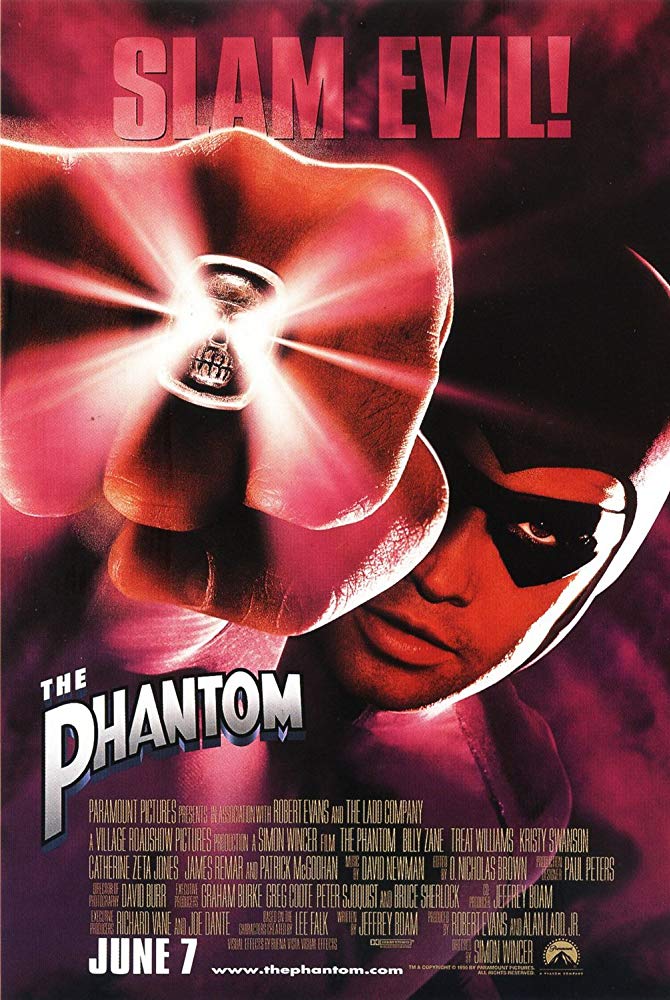
We’ve also welcomed the team behind The Phantom Game to various Supanova events. And we’ve even hosted the star of the live-action Phantom movie himself, the incomparable Billy Zane, four times, most recently at 2025’s Sydney and Perth events. In fact, it was while in our fair country to film 1989’s Dead Calm that Zane first became aware of the character, after seeing Phantom comics being read on set. And if that’s not enough of an Aussie connection for you, the Phantom film itself was partially filmed in Queensland. In many ways, you could say that Australia has been something of a second home for The Ghost Who Walks.
It’s impossible to truly pinpoint what exactly has made the Phantom such an enduring character, both here and around the world, but there’s no denying how beloved he is. Perhaps it’s no surprise that a jungle hero would find popularity in a land proud of its own bush heritage. Whatever the case, there’s something that makes the character so innately appealing and capable of standing the test of time, without undergoing major change. His strength of character, dry wit, rugged nature and commitment to good obviously resonate with the Aussie spirit. In many ways he reflects the kind of character we look for in ourselves – a bushman who embodies the ‘fair go’ attitude. So, while he may not really be immortal within the story itself, in reality he is unending. May the Ghost Who Walks keep walking for all centuries to come.