


No Guest Found in this category
Gold Coast Supa-Fans caught up with seasoned adaptors Isobelle Carmody, Maria Lewis and Amanda Bridgeman this month, at their ‘The Book Was Better’ panel, exploring authors’ experiences when crossing mediums with a story. Let’s get into what they covered!
Getting Approached
After an author has completed their book, there are a number of ways it can get adapted for the screen. One of these is with an agent.
Who’s Afraid author and screenwriter by trade, Maria Lewis, explained that you “usually have an agent who’s represented your work in terms of selling it to publishers.
“That agent has a vested interest in getting your book optioned, because every bit of the money you make, they get a percentage. You are partially a gravy train for them.”
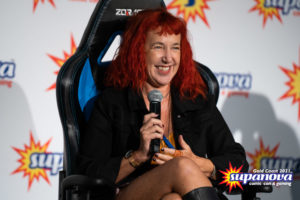
Author Isobelle Carmody. Photo by Jamie Bishop.
Getting a book “optioned” is essentially giving a film studio or other entity the rights to create a film or show from your story. The rights can be for your story, characters or world, and the contract under which you license them can be negotiated for price, your involvement in the adaptation, or aspects of the adaptation itself.
Literary agents can pitch or “sell” the opportunity to adapt your story to film studios, or studios can come to you to ask for them. Obernewtyn author Isobelle Carmody, whose work has been optioned many times, says her primary way of getting books “optioned” is getting approached, rather than doing the approaching.
“[The studio] write directly to you and they say, ‘Where can I find the rights?’ Sometimes I’m really startled to discover I have the rights – because I was mad with a publisher at that moment, and I refused to let them have some right,” Carmody tells.
“Because I’m completely non-business-like and I don’t have an agent, I can’t even remember what I own. I have to figure it out, and that means finding the contract, which is in the shed being eaten by rats. So, it’s really difficult for me.”
Making Money Off A Deal
When negotiating option agreements, an author is deciding certain Intellectual Property (IP) rights to give a film studio, and under what conditions. These can affect everything from how much the author is paid to what the adaptation will look like.
But according to Lewis, authors can get more money off selling the rights to adapt their work when the adaptation gets delayed or doesn’t get made, than when it does, “because they extend the option [the contract wherein they pay you to use your IP] every year.”
She says when a film studio needs to keep the IP for longer because the adaptation has slowed in development, that extends the amount of time that studio is paying you. For a lot of authors, a steady income constitutes, “rights to things that they’ve sold that are not getting made, but getting retained because people are paid to retain that.
“It’s such a weird process. It’s such a weird thing,” she says.
Carmody warns writers not to get in over their heads selling options. “The amounts are not huge. It’s a couple of thousands of dollars over and over again for maybe five or six years.”
View this post on Instagram
Getting Involved
Every writer has a different level of involvement they’d like in the adaptation of their work, from writing the screenplay to letting the studio do their thing.
Amanda Bridgeman, whose work has recently been optioned by Aquarius Films, would love to be in the writers’ room on her novel’s adaptation, but admits she would need help with the screenplay.
She says, “If you don’t have a strong screenwriting background, you’ll be in the writers’ room to help with the world and where things were going, and characters, and stuff. They will have an experienced showrunner… You’re just part of the writers’ room, but there’s an experienced showrunner leading it.”
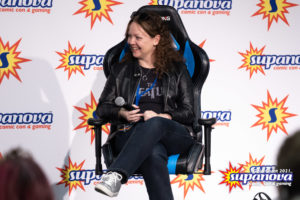
Author Amanda Bridgeman. Photo by Ewan Ly.
Even experienced screenwriters may only want to be attached to the project as a kind of story consultant, but all three writers on the panel agreed that the film studio is often eager to get a writer’s approval, no matter how involved they want to be.
“[The film studio] tell you that they’re gonna be really faithful to your creation,” Carmody says. “It’s like, in a weird way, they’re trying to suck up to you. And I think, ‘I’ve got no power! I don’t own the rights to this, the publisher has the rights. I know it’s another thing. I know I have no control over what you do with it. I’m completely irrelevant to the process. Why are you even talking to me?’
“It’s nice… but I don’t have anything to say.”
Sometimes, the biggest responsibility an author might have in the making of an adaptation is keeping it quiet. Bridgeman says the reason for this is an early announcement from an author could give the impression that an adaptation will come to fruition earlier than it actually will.
“These production companies don’t want it out there in the press,” she says. “Because if it doesn’t go and get made it could look like a failure. I think they just like to hold on until they know things are going ahead.”
Carmody says she doesn’t always get the memo that she’s not allowed to talk about it until it’s too late. “I just don’t know it’s supposed to be a secret, and I’m excited about it. Once I’ve blabbed to about a hundred people, then I’m told ‘don’t mention it yet.’ And I say, ‘Okay, I won’t mention it… from now on.’”
Isobelle Carmody, Maria Lewis, and Amanda Bridgeman’s insights on the Gold Coast gave fans a look into just how many different roles an author can play in screen adaptations of their work. Victorian fans can meet Lewis and Bridgeman this May at Supanova 2021 – Melbourne.
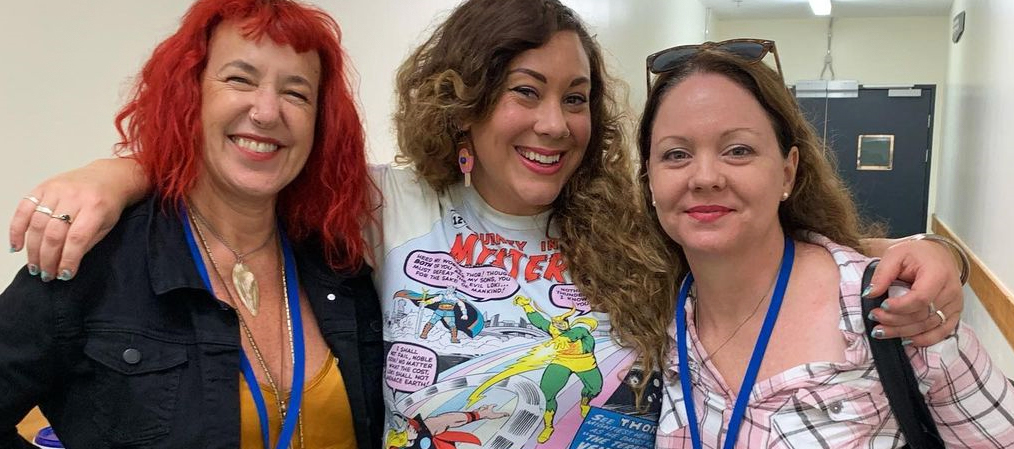
Lead Image: Isobelle Carmody, Maria Lewis and Amanda Bridgeman backstage at Supanova 2021 – Gold Coast.
Photo courtesy of Maria Lewis.